
East and West Sussex
Riding arena construction in East and West Sussex
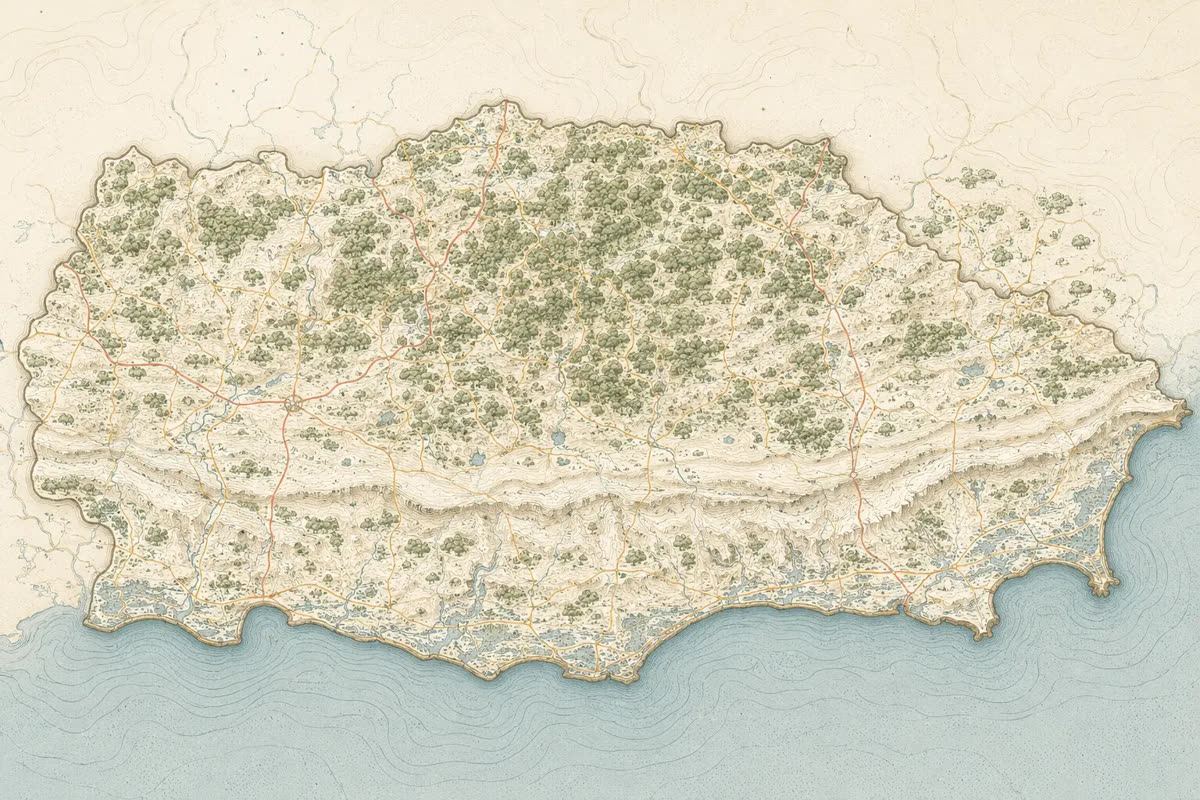
The ground
The Weald is heavy clay and the Downs are chalk, so Sussex asks the same question Kent does. On Wealden clay the drainage has to be specified correctly for the ground rather than to a standard detail. Nearer the coast, a high water table changes the design again.
This is why we survey on foot before quoting and why our guide prices are published as bands rather than a single figure. Anyone quoting an arena in Sussex without seeing the ground is either padding the price to cover the risk or is about to discover it at your expense.
Planning in East and West Sussex
The South Downs National Park is a planning authority in its own right, with its own policies and its own view on lighting and on how a new structure sits in the landscape.
Most well sited applications on land already in equestrian use are approved. Lighting is the usual sticking point. Our planning page covers the process in detail, including Biodiversity Net Gain, and we can handle the application for you.
Where the water goes in Sussex
Wealden clay in the north behaves exactly as it does in Kent. Nearer the coast the constraint changes to the water table: on some low lying sites groundwater sits high enough that a deep soakaway simply fills, and the design has to work with shallow lateral drainage to a positive outfall instead.
This matters more than the surface you choose. When an arena stops riding well, the cause is usually underneath it rather than on top of it: water with nowhere to go. The legal and physical route out is a Sussex specific question rather than a standard detail, and it is the first thing we establish on a survey.
Who has to agree to the water leaving
Sussex is two lead local flood authorities, not one: East Sussex County Council and West Sussex County Council, each consenting discharges into ordinary watercourses in its own area. A yard near the boundary can genuinely be dealing with either. Main river outfalls go to the Environment Agency in both. The practical effect is that a design which was consented for a neighbour is not automatically a template for you.
Orientation, not legal advice. The survey settles which regime applies.
The designation that decides it in Sussex
The South Downs National Park is the one that changes the process rather than just the test. Inside the park the South Downs National Park Authority is the planning authority itself, so the application does not go to the district council at all. The High Weald National Landscape covers much of the north east of the county and works the way National Landscapes do elsewhere, on how the arena sits in the view. Knowing which of the two you are in, and therefore who decides, is worth establishing before anything is drawn.
When to build here
Clay sites in the drier half of the year. Coastal sites are more about the water table than the season, and on those we would want to see the ground in winter before committing to a design if there is any doubt.
We will say so if we think you would get a better arena by waiting three months. A formation worked in the wrong conditions is a problem you live with for twenty years, and it is not worth a slightly earlier start.
Planning authorities in East and West Sussex
Applications in East and West Sussex are determined by bodies includingSouth Downs National Park Authority, Wealden District Council, Horsham District Council, Mid Sussex District Council and Rother District Council. Policy and the appetite for lighting genuinely differ between them, which is one reason a pre application enquiry is usually worth the fee.
Where we work in Sussex
We build routinely around Haywards Heath, Lewes, Horsham, Battle, Petworth and Uckfield, and across the rest of the county. Travel affects cost, so we would rather discuss it openly than quote as though it does not.