
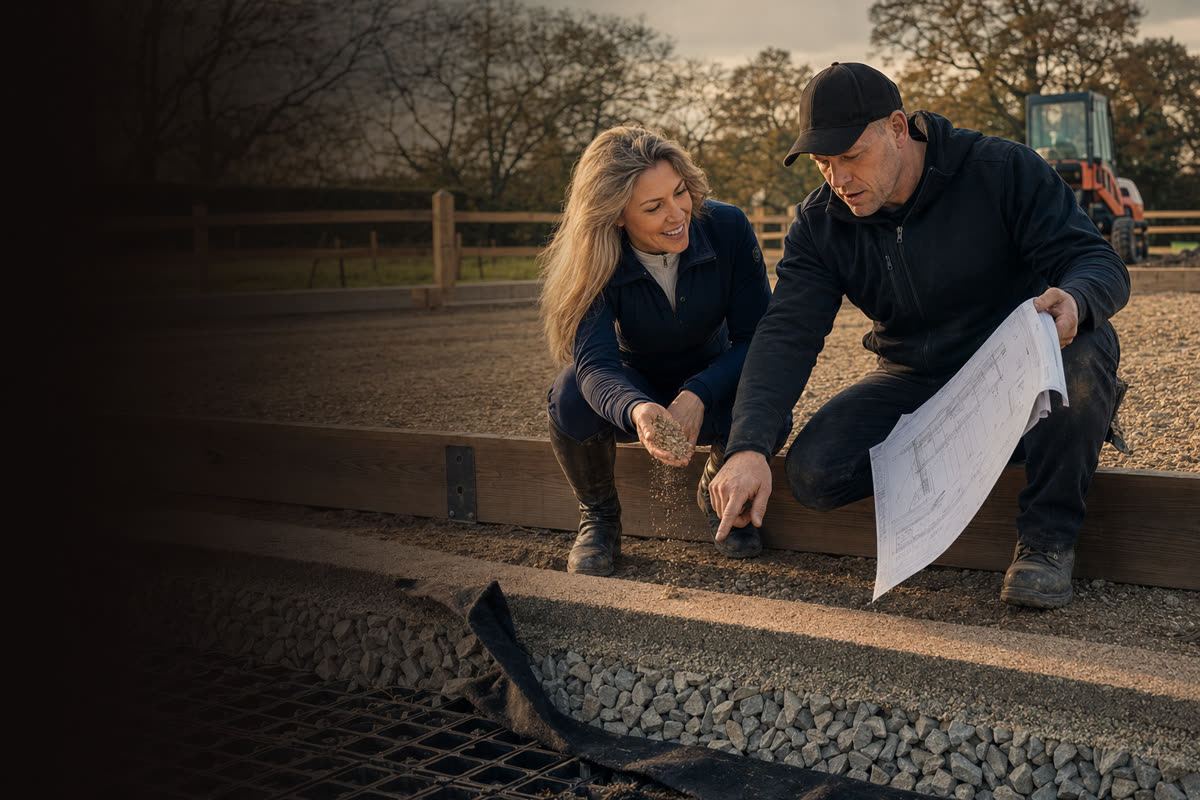
The Master of Arenas
Lewis Gill
A lifetime studying arena construction. Fourteen years learning the craft under Mark Scott Arenas, then co-founder of Chart Arenas.
Most arena builders are groundworkers who also do arenas. Lewis is the opposite: a true specialist, and that specialism is what turns a rider's requirements into ground that will still be performing in ten years.
“I am a perfectionist, and with every arena I build that enthusiasm to do better grows. Knowing that what I build can allow someone to get better results and happier horses makes me proud. When I sign off a project it is my signature and my reputation, which must produce better results for the customer.”
What this half knows
- Where the water goes
- Formation falls, lateral spacing designed to the permeability of the actual ground, a carrier sized to the catchment, and an outfall that is both legal and physically capable of taking it. Get this wrong and nothing else matters.
- What the ground will do
- How clay behaves against chalk, what a slope costs in cut and fill, where the water table sits, and whether a lorry can reach the site. These decide more of the final figure than the size of the arena does.
- How to make it hold
- Stone type and depth, compaction in layers to a tolerance rather than a guess, the right geotextile for that ground, and the rodding access that means the system can still be maintained in fifteen years.
- How a specification ages
- Twenty years of watching particular materials behave in particular ground, a decade after they went down, in February. That is the part a contractor who arrived at arenas last year cannot have.
Engineering and construction knowledge is what makes an arena achievable.
On its own it produces something that measures correctly in every dimension, handed to somebody who will find out how it rides later.
The Rider
Harriet Smith
Thirty years in the saddle, competing and producing horses across a huge variety of indoor and outdoor arenas.
That experience brings something that cannot be measured from a drawing alone: an understanding of how a surface actually performs beneath the horse.
“The more horses I have produced, the more important the surface beneath them has become. Good footing isn’t just about performance. It’s about giving the horse the confidence and support to do its job.”
What this half knows
- How a surface should feel
- A good surface needs the right balance of stability, grip and cushioning. It should support the horse through turns, take-off and landing without riding deep, shifting excessively or becoming inconsistent as the session progresses.
- How horses load an arena
- An arena is not used evenly. Corners, tracks, take-off and landing areas and frequently ridden lines experience very different forces. Understanding how horses move through those areas influences the surface specification, depth and ongoing maintenance required.
- Consistency under different horses
- A surface must work for more than one type of horse. A powerful horse, a lighter blood horse and a young horse can all interact with the footing differently. The aim is a surface that remains predictable, supportive and consistent across different workloads and conditions.
- What good footing feels like
- Years spent riding on competition and training surfaces creates a valuable point of comparison. The difference between a surface that simply looks good and one that allows a horse to travel confidently, stay balanced and work comfortably is felt through the horse.
Experience in the saddle can identify what an arena needs to achieve.
Together, those two perspectives determine how we build it.
Master of Arenas
Lewis Gill
A lifetime in arena construction.
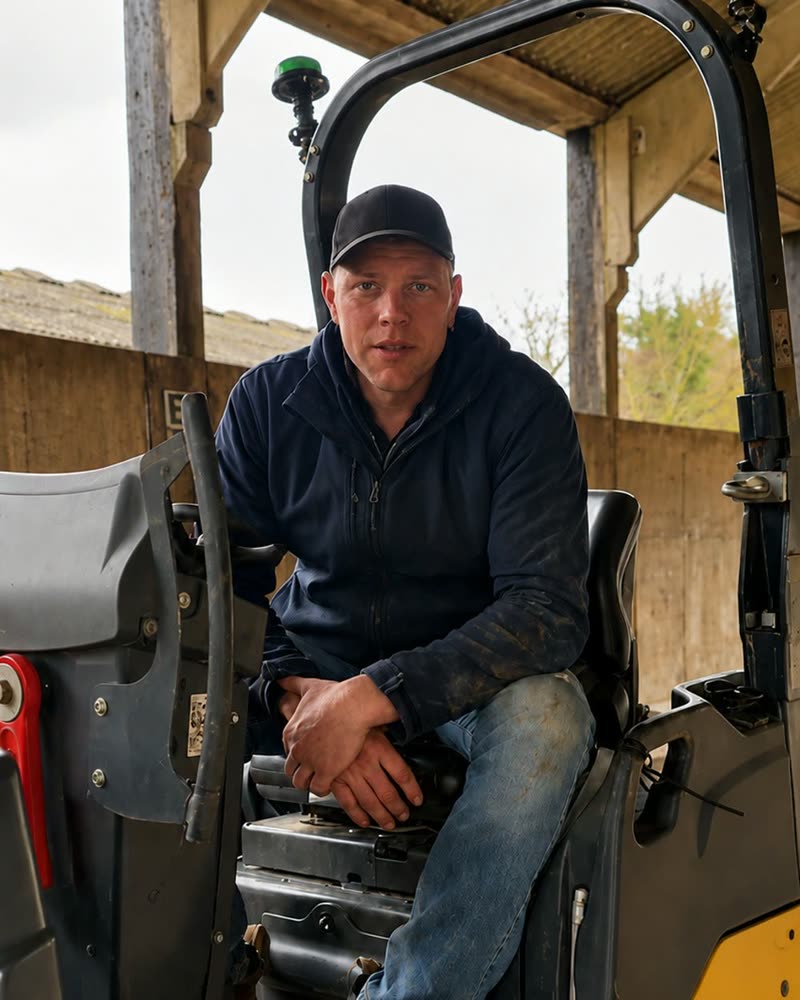
Lewis has been around arena construction since boyhood and has never done anything else. Fourteen years of it were spent learning the craft under Mark Scott Arenas, and he went on to co-found Chart Arenas. This is not a groundworker who also takes arena work. It is a man who has studied one thing for his whole working life.
That distinction matters more than it sounds. Most firms building arenas are groundworks contractors, and an arena is one of the things they do. The drainage will usually be competent because drainage is their trade. What tends to be missing is the twenty years of watching how particular specifications behave in particular ground, a decade later, in February.
He is doing this now to build arenas for people who want the best quality at a reasonable cost, rather than to undercut anybody. Competing on price in this trade means saving money where it cannot be seen, and the place it is always saved is underneath.
Showjumper, Horses Smith
Harriet Smith
Thirty years riding. Hundreds of surfaces.

Harriet has spent thirty years riding and competing across a huge variety of equestrian surfaces, indoors and outdoors, in training and competition.
That experience creates a very different understanding of an arena. From the saddle, the quality of a surface is felt through the horse: the stability through a turn, the grip on approach, the support at take-off and landing, how readily the horse can rebalance, and whether the footing remains consistent as the work continues.
Different horses expose different characteristics in a surface. A powerful horse, a lighter blood horse and a young horse may all interact with the same footing differently. Years of riding across different arenas creates an invaluable point of comparison.
The specification tells you how an arena is built. The horse tells you how well it performs.
That perspective is brought into the process before construction begins, helping ensure the arena is designed not simply to look right, but to perform for the horses and riders who will use it.
Harriet competes and produces horses at Horses Smith, the working showjumping yard that is one half of this partnership.
“Our arenas hide nothing under the surface.”
“Every inch is carefully constructed with the horse and rider's comfort in mind.”
The first of those is not a figure of speech. It is why every build runs a three stage sign-off, photographed and dimensioned before each layer is covered, and why you keep a record of where the whole system is installed.See what you get at the end →
The load does not stop at the surface
Every stride puts a horse's full bodyweight, plus the momentum behind it, through one foot at a time. The surface takes the first part of that. Everything it does not absorb travels upward.
It passes from the hoof into the pastern, then into the fetlock, which drops and extends under the load before recoiling. Behind the cannon bone, the flexor tendons and the suspensory ligament stretch to support that drop and then return the energy.
How much of that load the horse carries, and for how long, is decided by what is underneath. A surface with too little give sends concussion straight up the limb. One that is too deep lets the fetlock drop further and holds it there longer, which is where the strain accumulates over a session rather than in a single step.
This is the part of an arena a specification sheet cannot show you, and it is the reason the footing is chosen for the horses that will actually work on it.
Four things they argue about
The useful part of this pairing is not that the two of them agree. It is that the disagreements happen in front of you, before anything is dug, instead of being discovered by you three winters later.
How deep should it be?
The Rider says
Deeper feels softer and more forgiving, and most riders asked directly will ask for more than they need.
The Master of Arenas says
Deeper means more material, more movement and a surface that migrates faster, so it needs more binding and more maintenance to stay where it was put.
What you get
Depth is specified to the material and to what you actually ride, then measured at multiple points rather than averaged. Too deep is where soft tissue injuries come from, so this is one the rider has to be argued out of as often as into.
Where should the arena go?
The Rider says
Somewhere sheltered, close to the yard, out of the wind, on the flattest bit.
The Master of Arenas says
The sheltered flat spot is very often the bottom of the slope, which is where everything the field sheds arrives. No drainage inside the arena fixes what is coming from outside it.
What you get
Siting is settled on the survey, together, on foot. Sometimes the answer is to move it thirty metres and sometimes it is to accept the spot and pay for the drainage it demands. Both are fine. Discovering it afterwards is not.
Which surface?
The Rider says
The one that rides best. Wax, usually, because it is consistent in February as well as July.
The Master of Arenas says
The one that suits the base, the drainage, the budget and the maintenance the client will realistically do. A plain sand surface that is levelled weekly rides better than a waxed surface that is neglected.
What you get
The specification comes from a conversation about what you ride and how much looking after it will actually get, rather than from whichever product the contractor stocks.
Is it finished?
The Rider says
Not until it has been ridden, in both directions, and over a fence where that is what it is for.
The Master of Arenas says
Levels, depths and compaction are all inside tolerance, and by every measure available it is complete.
What you get
Both are true at the same time, and that is exactly why the ride check exists. What comes out of it is a snagging list about how it rides rather than how it was built, and it is usually short and always worth having.
Neither half of this is unusual on its own. There are master builders of arenas and there are riders with thirty years of opinions. What is unusual is putting them in the same conversation before anything is dug, and keeping them there until after the first winter.
Four things a rider knows that a spec sheet cannot hold
Not opinions. Each is a real property of a riding surface that is only legible from the saddle, set against the number a master of arenas would correctly report. Both columns are true at once, which is exactly why you want both people.
What the rider feels
Depth
A surface fifteen millimetres too deep looks identical and rides completely differently. You feel it in the third circuit, not the first: the horse working harder than the session warrants, the stride flattening, a hind end that tires early. Over a winter that is not just tiring, it is where soft tissue injuries come from.
What the build measures
A builder measures depth with a probe and gets a number that is within tolerance. Both statements are true at once.
What the rider feels
Consistency across the arena
A horse tells you the moment the surface changes underneath it. Coming out of a corner onto a firmer track, or meeting a soft patch three strides from a fence, produces a hesitation you feel before you could ever see it. An arena that averages correctly can still ride badly in the two places you use most.
What the build measures
A builder measures an average, and an average is exactly what hides this.
What the rider feels
Grip and slide
How far the foot travels before it stops is the difference between a horse that turns back confidently to a fence and one that starts running through the shoulder. Too much slide and it loses trust. Too little and the leg stops dead while the body keeps going, which is torque straight into the joint.
What the build measures
There is no number on any specification for this. It is a judgement, and it is made from the saddle.
What the rider feels
What the horse gives back
Some surfaces return energy and some absorb it. A horse jumping out of a dead surface has to generate everything itself and will start backing off a fence it was jumping happily a fortnight ago. That change in behaviour is a surface report, delivered early, by the only party with a direct interest in the answer.
What the build measures
By the time this shows up in anything a builder would notice, it has been going on for weeks.
Why the gap exists
This is not a criticism of builders. Arena construction is civil engineering: drainage design, formation levels, compaction, material specification. It is genuinely difficult work and the good firms are very good at it. Lewis has spent a working lifetime becoming one of them.
But the finished product is not a structure. It is a surface that a live animal moves across at speed, carrying a rider, turning and landing on it several hundred times a session. Everything that matters about it is expressed as feel, and feel is transmitted through the horse to the person sitting on it.
So the industry has a structural blind spot. The people who build arenas mostly do not ride them, and the people who ride them mostly cannot say why one works and another does not. Both halves hold real knowledge and they usually never meet.
What the two halves actually do together
The specification is chosen from a conversation about what you ride, not from a catalogue. A dressage horse working deep and round through the back wants something different from a young jumper learning to be brave to a fence. Those are different surfaces, and the difference is decided by somebody who has ridden both.
During the build, the rider's questions are asked while they can still be answered. Where does the track want to be. Which corner will get the most work. Is that the right depth for a horse that is going to be schooled on this five days a week in February. Those questions cost nothing to ask during construction and are expensive to answer afterwards.
And at handover the arena is ridden rather than only inspected. The finished surface is assessed from the saddle for consistency, stability, depth and feel, with consideration given to the discipline and the horses it was designed for.
The ride check
Every arena we build is ridden before we call it finished. Not walked, not measured, ridden, properly, in more than one direction and over a fence where that is what it is for.
What comes out of that is a snagging list about how it rides rather than how it was built. Depth adjusted where it needs it. The track eased where the going changes. Levels corrected in the corner that will take the most traffic. These are small changes and they are the difference between an arena that is technically correct and one that is genuinely good to ride on.
We come back at four weeks, once it has settled and been used, and again after the first winter. A surface tells the truth in February, not in July, and by then most contractors have long since been paid and gone.
What this is worth to you
Practically, it means fewer of the things that make owners quietly disappointed with an arena they spent thirty thousand pounds on. The one that is fine except for the corner. The one that rides deep by March every year. The one nobody can explain, because everything about it measures correctly.
It also means that when something does change, you have somebody to describe it to who will understand what you are saying. Telling most contractors that your horse has started backing off in the top corner produces a blank look. Here it produces a diagnosis, because it is a sentence we recognise.
We are not claiming other builders do bad work. Plenty do excellent work. We are claiming that a surface is judged by feel, that feel is only available through a horse, and that we are the only arena builder in this market with a rider inside the build rather than standing on the other side of it.